İnşaattan sorumluyuz----- üretimden sorumluyuz----- eğitimden sorumluyuz

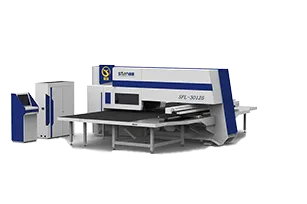
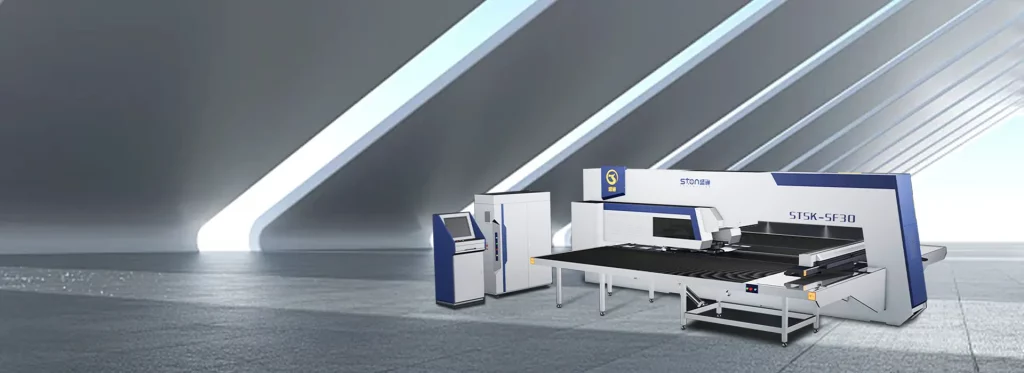
A CNC turret punch press forms holes, louvers and cutouts by driving a punch through sheet metal at a fixed station, then rotating a tooled turret to the next shape. Below are the station counts, tonnage, and accuracy figures that actually separate a mechanical model from a servo one.
The turret is the part that gives the machine its name: a rotating disc loaded with dozens of punch-and-die sets, indexed into position by the control system before each hit. A ram — mechanical flywheel-driven or servo-electric — then drives the punch through the sheet. Between hits, the sheet itself moves on X/Y guideways so the same tool can strike multiple locations without a tool change.
This is different from a press brake, which bends a formed blank, and from a laser, which cuts a continuous path. A turret punch is built for repetitive, discrete features — round holes, louvers, slots, embossed ribs — on flat or lightly formed sheet. Where a part is mostly holes and standard shapes, a punch press produces them per hit rather than per millimeter of cut path, which is where its cost-per-part advantage over laser tends to show up.
Taret Punch Presi
Both machine types use the same turret concept, but the drive system changes turret speed, power draw and how the machine behaves under continuous high-frequency punching. These are the published parameters for STON’s JT Series (mechanical) and SF Series (servo-drive) turret punch presses:
| Parametre | JT Series (Mechanical) | SF Series (Servo) |
|---|---|---|
| Maximum Turret Speed | 30 dev/dak | 40 rpm |
| Machining Accuracy | ±0,1 mm | ±0,1 mm |
| Maximum Load Capacity | 150 kg | 150 kg |
| Combined Power Consumption | ≤2 kW | Yaklaşık 3–5 kW |
| Hava Kaynağı Basıncı | 0,55 MPa | 0,55 MPa |
| Güç Kaynağı | 380 V ±5% | 380 V ±5% |
| Control Platform | Windows-based, RTEX bus servo unit; FANUC, Siemens, or Rexroth optional | Windows-based, RTEX bus servo unit; FANUC, Siemens, or Rexroth optional |
The accuracy figure is identical on paper — the real difference is duty cycle. The mechanical JT Series uses a flywheel system that stores rotational energy and releases it on each strike, which keeps motor load down but caps how fast the turret can index between hits. The SF Series drives the ram directly with a servo motor, which is what lets turret speed climb from 30 to 40 rpm without extra motor strain. If your job mix is dominated by high hole-count panels — perforated vent covers, mesh-pattern doors — that 10 rpm difference compounds fast over a shift; if most parts have a handful of holes and one or two forms, the mechanical machine reaches the same accuracy at a lower power draw.
Both series share a worm-gear turret with an internal copper shaft structure for the rotary stations, a double-chain drive mold system rated for over a year between chain-tension adjustments, and over-tonnage protection that disengages the clutch or cuts impact power before an overload reaches the crankshaft or dies.
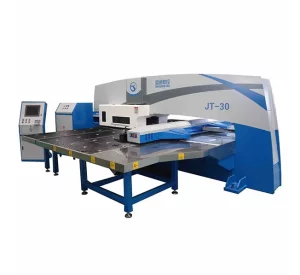
STON JT Serisi
Punching wins on parts where the geometry is mostly repeated standard shapes: round or slotted holes, louvers, knockouts, embossed ribs. Because the tool forms the shape in one hit rather than tracing an outline, a 500-hole ventilation panel can come off a turret press faster than the same panel would cut on a laser, and the tooling cost per hole is lower once the die is in the turret. This is why vent grilles, perforated cabinet doors and switchgear/electrical panel backplates are the classic turret punch parts — the STON product line lists punching-hole panel factories, ventilation plate manufacturers and electrical panel factories among its core buyers for this equipment.
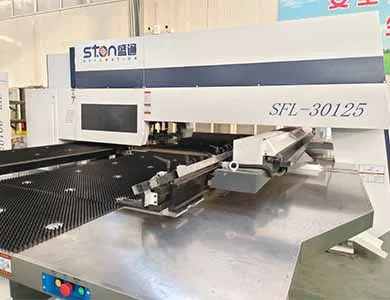
Laser wins once the part geometry moves away from repeated standard shapes — free-form contours, one-off prototypes, or thick material outside the punch press’s practical range. A punch-laser combined machine exists precisely for shops that see both job types: STON’s SFL Series pairs a punching head (300–400 kN / 30–40 T rated force) with a laser head on one bed, handling sheet up to 2500 mm in a single position (extendable to 5000 mm with secondary positioning) and punching at up to 405 strokes per minute for standard hole patterns, switching to the laser for the non-standard cuts on the same clamping.
The most common misjudgment in turret punch selection isn’t tonnage — it’s assuming more turret stations automatically mean more capability. Both the JT ve SF Series ship with rotary station control on two independent positions (1B/1C-type rotary stations), and the practical ceiling on how many distinct hole sizes a job needs in sequence is usually set by mold change time and rack-and-pinion positioning accuracy, not by how many stations the turret physically holds. A job that alternates between four hole diameters across a panel spends more time on X/Y repositioning than on turret indexing — so a machine with a stiffer feed system (STON’s dual dovetail beam and patented double-triangular beam mounting bracket, sized to reduce load on the lead screw) can outrun a machine with a larger turret but a less rigid feed axis. Ask for cycle time on your actual hole pattern, not just a station count, before comparing two quotes.
1.Sheet thickness and material you actually run — carbon steel, galvanized, or stainless each have different practical punching limits before hole tearing or die wear becomes a problem.
2.Maximum punching diameter in one shot — STON’s SFL combined series lists 6 mm in a single hit, with larger diameters (up to Ø88.9 mm) requiring the 25.4 mm step-and-repeat nibbling method.
3.Turret speed and step pitch — the SFL Series’ 405 strokes/minute step pitch is a useful benchmark for comparing high-volume perforation jobs across vendors.
4.Load capacity of the feed system — 150 kg on both JT and SF Series caps how large or heavy a single sheet the machine handles without secondary support.
5.Die/tooling compatibility — confirm whether the turret takes standard international 85-series long-guide molds (16A, 11B, 3C, 2D die types) so tooling isn’t locked to one supplier.
6.Control system options — Windows/RTEX is standard; FANUC or Siemens control upgrades matter mainly if your shop already standardizes on one CNC platform across other machines.
Turret punch presses fall under machine-press safety standards, not general CNC guarding rules. EN ISO 16092 and EN 12622 cover the mechanical safety requirements specific to press and hydraulic bending machines, and for equipment sold into the EU, compliance with the Machinery Directive 2006/42/EC is a separate requirement from ISO 9001 quality certification — the two are often confused but address different things. If you’re evaluating an import machine, ask specifically which of these the unit is certified against, not just whether it’s “CE marked.”
STON does not publish a fixed price list for turret punch presses — tonnage, station count, servo vs mechanical drive, and any punch-laser combination all move the price, and the honest answer is that you need a quote against your part drawings, material range and target output rather than a number pulled from a spec sheet. What you can budget for in advance is the variables that drive the quote: drive type (mechanical vs servo), turret configuration, and whether you need the SFL combined punch-laser bed instead of a standalone punch press.
Q: What’s the difference between a mechanical and a servo turret punch press? A: Both hit similar accuracy (±0.1 mm on STON’s JT and SF Series), but the servo-driven SF Series indexes the turret faster — 40 rpm versus 30 rpm on the mechanical JT Series — at the cost of roughly double the power draw (3–5 kW vs ≤2 kW).
Q: Can a turret punch press cut curved or free-form shapes? A: Not efficiently with punch tooling alone. Free-form contours are better suited to laser cutting; a combined punch-laser machine, like STON’s SFL Series, lets one bed do both without re-clamping the part.
Q: What sheet thickness range does a turret punch press handle? A: This depends on tonnage and die selection rather than a single fixed number — STON specifies material and thickness range per model during quoting rather than as a universal figure, since carbon steel, galvanized sheet and stainless behave differently under the same punch force.
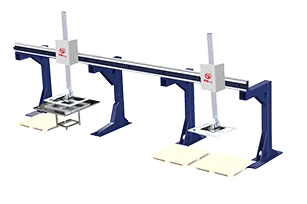
Q: Do I need automatic loading and unloading with a turret punch press? A: Only if volume justifies it. Both the JT and SF Series retain standard interfaces for robotic arm or gantry loading systems, so automation can be added later without replacing the punch press itself.
İster mevcut bir hattı geliştiriyor ister yeni bir projeye başlıyor olun, STON üretiminiz için bir CNC çözümünü özelleştirecektir.